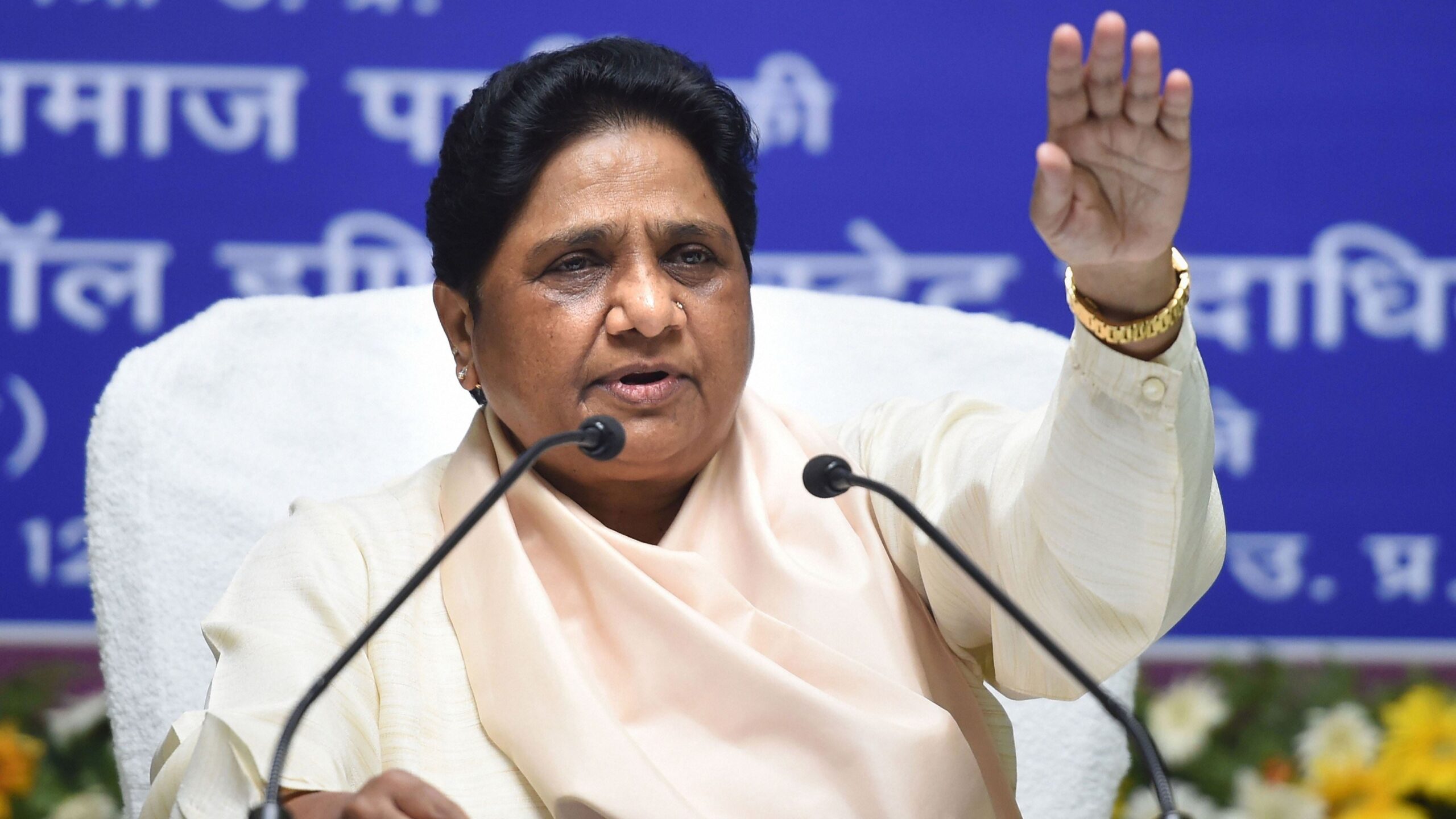
New Delhi | After remaining out of power in Uttar Pradesh for nearly 15 years, the Bahujan Samaj Party (BSP) appears ready to revive the political strategy that once delivered it a historic mandate. BSP supremo Mayawati is once again working to consolidate the Dalit–Brahmin–Muslim alliance, the same social engineering formula that powered her to a decisive victory in the 2007 Assembly elections.
The BSP last ruled Uttar Pradesh from 2007 to 2012. Since then, the party has suffered defeats in three consecutive Assembly elections and performed poorly in three Lok Sabha elections. During this period, Mayawati significantly reduced her presence in active election campaigning, leading to a widespread perception that her political era was nearing its end.

However, as preparations for the 2027 Uttar Pradesh Assembly elections gather momentum, fresh political churn suggests otherwise.
The 2007 Blueprint
In the 2007 Assembly elections, Mayawati scripted history by winning 206 of 403 seats with 30.43 percent vote share—an unprecedented achievement for the BSP. This victory was not limited to the party’s traditional Dalit base. It was made possible through a carefully calibrated coalition of Dalits, Brahmins, non-Yadav Other Backward Classes (OBCs), and Muslims.
Dalit voters formed the party’s backbone:
- 86% of Jatav voters,
- 71% of Valmikis,
- 53% of Pasis, and
- 58% of other Scheduled Castes supported the BSP.
With Dalits accounting for nearly 21 percent of Uttar Pradesh’s population, this support provided a strong foundation.
Crucially, 16 percent of Brahmin voters backed the BSP. The party fielded 51 Brahmin candidates, of whom 20 were elected. Though their victories were largely driven by Dalit votes, Brahmin participation proved electorally decisive. Support from Thakurs and other upper castes, though limited, also contributed.
Among OBCs, nearly 30 percent of non-Yadav and non-Kurmi voters supported the BSP. The party fielded 110 OBC candidates, benefiting from voters disillusioned with other parties and attracted by promises of governance and development.
The most surprising element was Muslim support. Despite Muslims forming around 19 percent of the state’s population, surveys indicated that 17 percent of Muslim voters backed the BSP in 2007. The party fielded 61 Muslim candidates, 29 of whom won. Disenchanted with the Samajwadi Party, many Muslim voters responded to Mayawati’s assurances of minority welfare.
Signs of a Revival
Nearly two decades later, similar political currents are visible again. In the run-up to 2027, Brahmin and Muslim voters appear to be reassessing their political choices, with the BSP emerging as a renewed option.

Among Brahmins, dissatisfaction with the Yogi Adityanath-led BJP government is growing. There is a perception that Brahmins have been sidelined in administration and governance. This sentiment is reflected in a steady stream of Brahmin leaders joining the BSP.
- In January 2026, senior BJP leader Radheshyam Pandey from Ambedkar Nagar joined the BSP with 51–100 supporters.
- In December 2025, prominent Brahmin leaders such as Jitendra Mishra, Deepak Dwivedi, Neeraj Pandey, Vishal Mishra, Vaibhav Dubey, Anurag Shukla, and Mohit Sharma switched from the BJP to the BSP.
- Another major Brahmin leader joined the party in January 2026 after meeting Mayawati.
These defections are being seen as a significant pre-election setback for the BJP.
Muslim Discontent with SP
Muslim voters, too, appear increasingly disillusioned with the Samajwadi Party. There is a growing belief that while the SP seeks Muslim votes, it fails to adequately safeguard Muslim interests. Party insiders cite the treatment of senior leader Azam Khan and the circumstances surrounding the deaths of Atiq Ahmed and Mukhtar Ansari as examples of perceived political abandonment.
Many in the Muslim community feel that during critical moments, SP chief Akhilesh Yadav distanced himself, prompting a search for an alternative political platform.
Playing the Brahmin Card Again
Recent actions by Mayawati indicate a deliberate effort to reassert the “Brahmin card.” Her strong stance against the University Grants Commission’s new rules—urging that no one be harassed without reason—was followed by a forceful demand to ban the Bollywood film ‘Ghooskhor Pandit’, which she said insulted the Brahmin community.
In an X post on February 6, Mayawati wrote that portraying “Pandits” negatively in films has caused deep anger within the Brahmin community and demanded an immediate ban on the caste-targeted film. The issue has also put the BJP on the defensive, with Chief Minister Yogi Adityanath ordering an FIR related to the film in a bid to reassure Brahmin voters.
Back to Social Engineering
In 2007, Mayawati’s social engineering broke traditional caste barriers. Dalits remained the core with 80–86 percent loyalty, while support from 16 percent Brahmins, 30 percent OBCs, and 17 percent Muslims propelled the BSP from 23 percent vote share in 2002 to over 30 percent in 2007.
Today, political observers believe that Mayawati’s renewed outreach—especially her recent statements and social media posts—signals a conscious attempt to recreate that winning coalition.
As Uttar Pradesh heads toward the 2027 Assembly elections, the return of the Dalit–Brahmin–Muslim alliance could once again reshape the state’s political landscape. Whether history will repeat itself remains to be seen, but Mayawati has clearly placed her bet on the formula that once delivered her absolute power.












 https://www.youtube.com/watch?si=RtToJsBhYBatUrym&v=mOuYNSdhjHA&feature=youtu.be